
Depending on the amount of risk you want to assume, you can order at any time. There are many pressures regarding delivery and erection to consider.
However, there are some things that can help guide your decision.
Planning approval can give you some certainty, whether it is exempt guidelines, certification approval, or council approval. Once you have confidence that what you are buying is going to be approvable is really what should be determining when you buy.
We often hear clients say:
“the shed company is having a sale that ends soon, so how long does an approval take?”
“When can I order?”
To answer that question we need to know:
- what approval pathway the proposal meets?
- If your project meets the Exempt development requirements
then it’s just a matter of declaring the development with the council. If it meets the Complying development requirements and you have all of your documentation ready, they can be as quick as 30 days, Development applications through council are meant to be the longest but in saying that, we often get DA’s approved quicker than CDC. Every site is different.
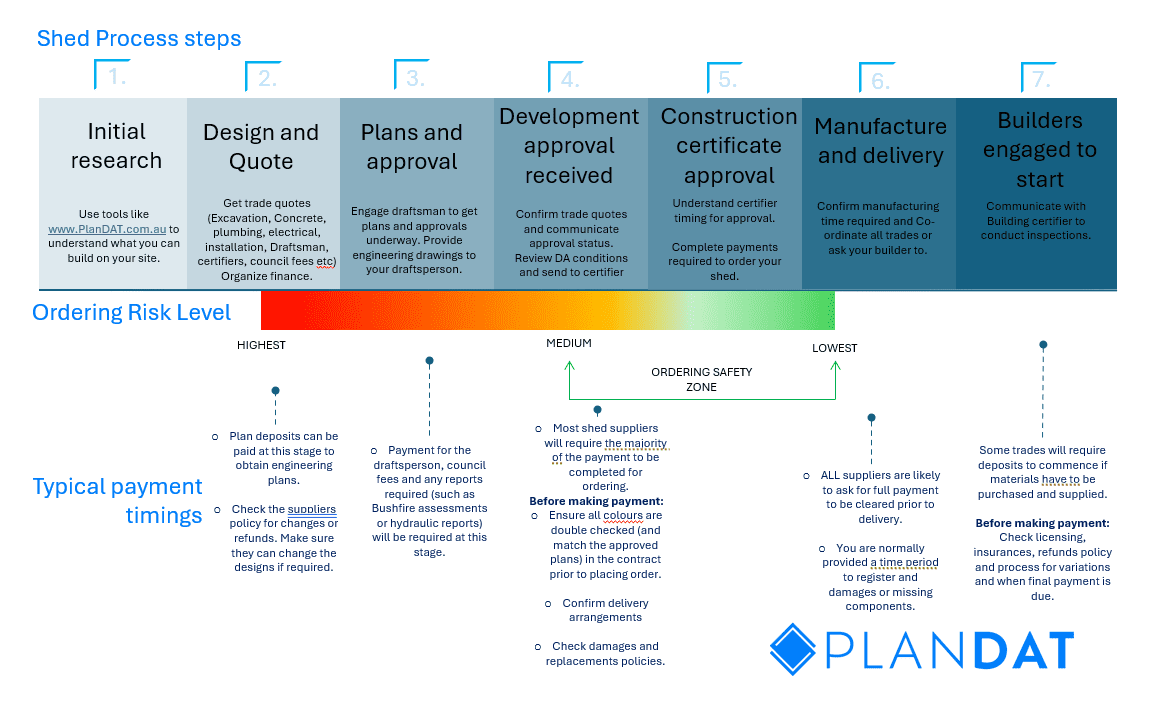
However, there are also some risks involved to acquire that benefit:
Damages and replacements- Your supplier will require you to go through the kit and make sure it has been delivered in full and will give you a period of time (normally around 7 days) to claim damages or missing parts.
- If a steel kit is laying on the ground exposed to sun and moisture, the materials do get damaged. The supplier now has nothing to do with it. Moisture on gal or zincalume steel will leave white marks. Insulation such as sarking or blanket will become corroded. A lot of flashings come with plastic on them and if partly unwrapped can cause discoloration of the colour coated steel.
- This is potentially the biggest risk if the job hasn’t been assessed by a professional. If the council doesn’t want to set poor precedence they can ask you to reduce the height, length or width.
- In October 2023 there was a wind code change that affected most engineering for sheds, if you had ordered the shed before getting approval and were not able to start building before the engineering changes were implemented, the customer had to pay for the difference in materials to upgrade to the new engineering standard.
- Sheds are made of many different components sourced from many different suppliers. If one of those suppliers changes while you are waiting for an approval, you may not be able to get the same parts again and furthermore may need to replace componentry in your kit to match the new suppliers.
How do I find out what can be approved on my property?
This is one of the reasons PlanDAT was developed – to get you on the right path as early as possible. The PlanDAT guidelines provide you with a host of options that indicate what the approving authority applicable to your site will allow to be approved on your site. PlanDAT tells you what your boundary offsets need to be, what your maximum height is allowed to be and most importantly what the maximum size (Roof area m2) is for your zone and property size. It tells you if CDC is possible on your site and what the requirements are if it is possible. This is a really handy tool however PlanDAT is a paid report, it costs $49.95 per report and still does need to be confirmed by a certifier before an approval can be issued. It does get emailed back to you within seconds which is really helpful if your in a rush to make a decision. Check your address below:
So what other options are there to get confidence before you commit to purchasing your shed?
You can call a Town planner or Private Certifier or Council directly and get them to provide information to you. This allows for some, albeit uncertain, guidance. The question is whether some vague advice from council, or some reference to state legislation gives you the certainty that you need to make an informed decision? For many people, it isn’t enough certainty. Especially with a host of extenuating factors that can influence a council, certifier or exempt development decision. Additional avenues for advice includes (as mentioned above), making an appointment with a town planner for advice, calling your local council and asking for some planning advice or guidance, seeking a pre-submission meeting for some advice from your council, building surveyor or certifier. The best sense of certainty you can get is Approval. Seeking formal written approval from council or a certifier is the most certain sense you can take that you are good to order your kit. The Development Approval and Complying Development Certificate Approval, when issued is the seal of approval that the size and height of the shed is acceptable. In our collective opinions, The best practice process for when to commit to a shed purchase is as follows:- Get a PlanDAT report
- Take your PlanDAT report to your shed supplier to help design your shed
- Get plans underway and fully understand your budget.
- Submit your application
- Obtain approval
- Take the approval to your shed company to negotiate a deal on an approved shed
- ORDER YOUR SHED
- Obtain Construction approvals (or building permits). Note: This step normally takes the same amount of time as the shed manufacturing process.