
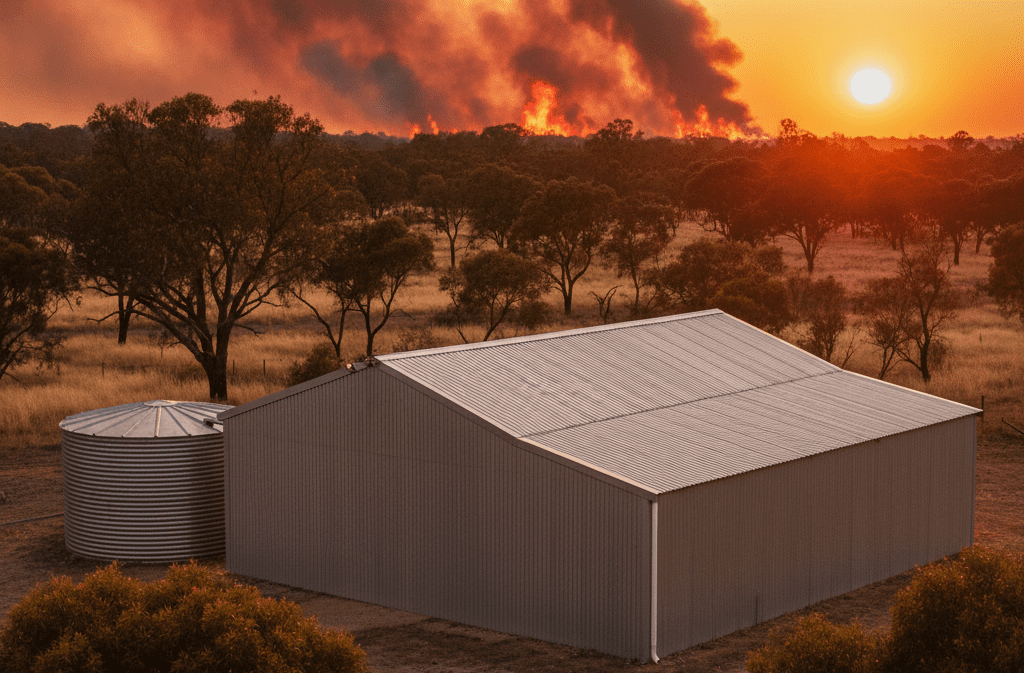
After a Bushfire has ravaged a community, a shed is often the first major purchase after it to enable to property owner to get any property assets that have survived secure and undercover. We did a lot of the 2019 ‘Black Summer’ Bushfire recovery work on the east coast and were attending sites not long after fire crews had left and the owners were left with the devastating clean up. When on site, the owners often all had the desire to share the detail of how the fire attacked their property from wind direction, to fuel sources, whether or not they were supported by local fire crews or not and what their movements were when the fire hit. One of the most common threads spoken about was how poly rain water tanks were often another fuel source. One particular story, was a client in Bargo, NSW. He was on the opposite side of the Valley to Buxton where he was observing the fire and watching and listening for updates from local authorities. He spoke about how he felt pretty safe watching the fire where it was and felt that he had enough vegetation cleared behind his house that he felt his house would be ok. It was a small rural property (around an acre from memory) with a shed and a pool around half way down the block and the house at the front near the street. From what was left of the property when I arrived on site, it looked to be a well maintained property also.
He said his nerves started to increase when his neighbour yelled out that he was leaving and that he should too. The nerves increased again as a water bomber (helicopter) came towards his house and held its position above his inground fibre glass swimming pool. He watched at the bomber lowered its bucket into his pool sinking to the bottom and very soon after lifting up and taking off again.
He said it was not long after the bomber had used all the water in the pool that the ember attack started. He described the ember attack being not quite as he expected. He said that he had seen ember travelling out of a bonfire before and that was what he expected ember attack to be. The ember attack that he now found himself in the middle of was described as Garbage bag size clumps of burning branched and leaves. He watched as they landed in his yard and he quickly tried to hose them out. He still felt like he was on top of protecting his major assets until one of those clumps of burning embers landed on his half full poly rain water tank. Within seconds the poly tank ignited and was quickly transferring to the shed (and its contents). His neighbour too shared a passion of collecting things he didn’t need and also had a shed and poly water tank next door. Before long they too were a lite. I questioned whether the water in the tank served as any help to extinguish the fire as it lowered to the water level however he said that “as soon as the tank started melting, the tank split and all of the remaining water immediately dispersed over the ground below where there wasn’t any fire at all.
Now, after all of the projects that we attended post the disaster, I don’t think that any particular water tank product would have survived the intensity of the majority of the fires (we did see steel water tanks completely split and buckled also) However, there was certainly a consistency across the sites about plastic water tanks contributing as a fuel sources. The irony is that in most of these cases, the poly tanks were positioned at the rear of the shed where there was dense vegetation adjoining the property and the clients had likely installed the tank thinking that it could one day be used to defend their property only to find out that they had strategically position a fuel source.
Other products to help defend your shed against Bushfire.
In NSW there are regulatory (including BASIX) requirements for water tanks to be used for fire fighting purposes on rural properties.
If the domestic water requirements for the property are 40,000 litres, you would require an additional 10,000 litres (<1 ha) or 20,000 litres (>1 ha). There is also a requirement for a Bushfire assessment if you are positioning your proposed shed within 6m of a dwelling. Normally a bushfire report (prepared by a Bushfire assessor) will ask for you to use a self extinguishing insulation and double layer ‘fire check’ on the wall parallel with the dwelling.
However, surprisingly, we haven’t seen any other requirements placed on domestic sheds. BUT there are plenty of products available to help protect you and your assets from fire such as:
Ember Seals.
Ember seals come in two different types of materials . The first one acts to block the gaps between the sheets and flashings and the other also sits in the same position however is self extinguishing. The sealing strips come in different sheeting profiles to match the cladding supplied by your shed supplier (corrugated etc)
-
-
-
- Eaves seals
- Floor seals
- Ridge seals
-
-
Windows and Openings
-
-
-
- Steel mesh (flyscreen)
- Head seals.
- Roller door brush seals.
-
-
So if you are planning to build and you rain a Bushfire affected area, use PlanDAT to find out:

make sure you are asking your supplier about the above products and using a concrete inground water tank (best option) or a steel water tank.